 World of Aletheia
Watercraft, Weather, and Civilized Shores
Overview
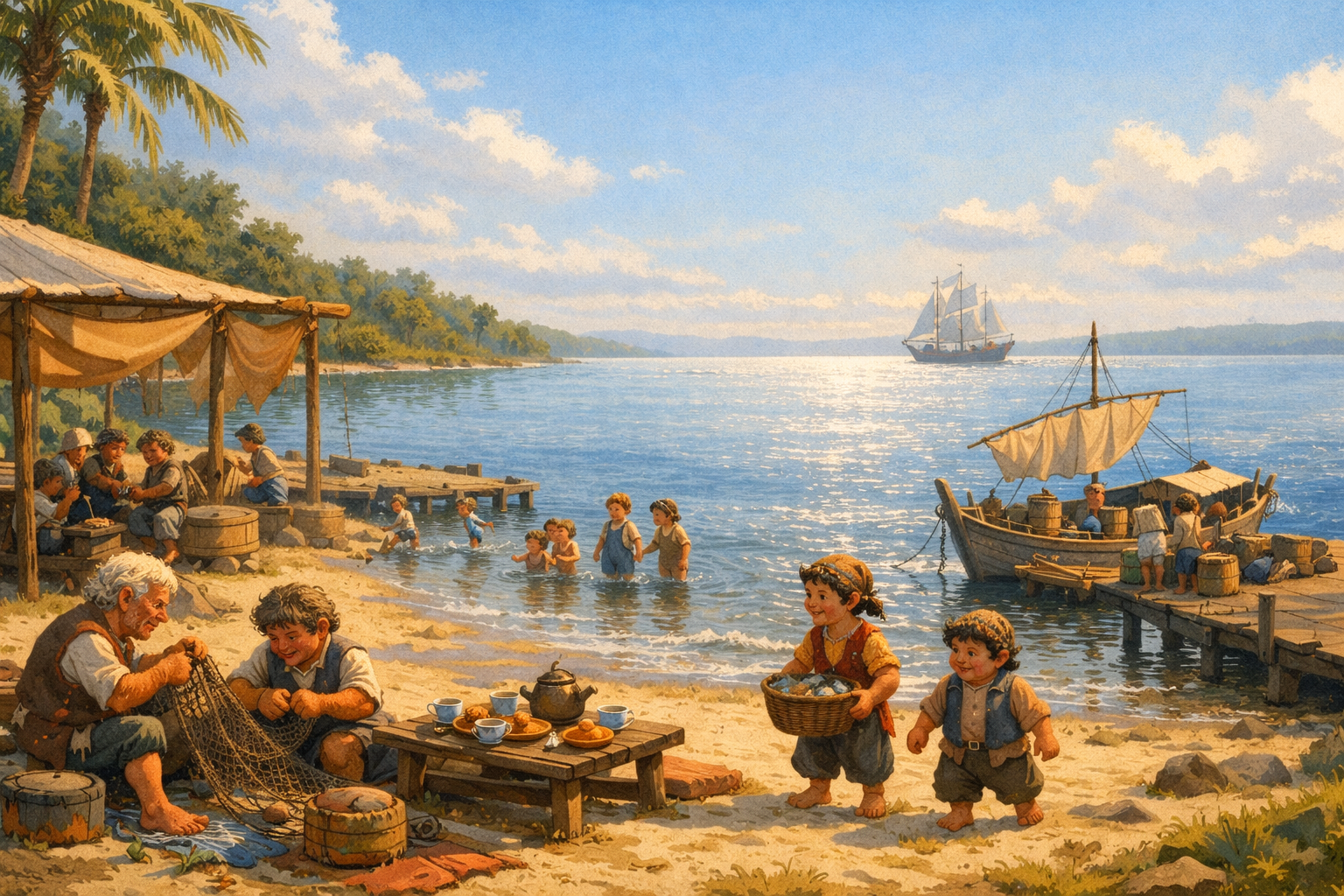
Along the equatorial shores of the Shining Lake, halfling communities have developed a water-oriented culture shaped by fishing, ferrying, and basin-wide trade.
Unlike old tales that cast smallfolk as wary of deep water, lake halflings are confident swimmers, capable sailors, and practical boat-builders. The Shine is not feared. It is respected—and used.
They remain unmistakably halfling in temperament: communal, comfort-minded, and measured. But their horizon is water rather than grass.
Settlement and Shore Life
Lake halfling settlements cluster along sheltered coves and river mouths. Typical features include:
-
Low-profile dockyards
-
Smokehouses and drying racks
-
Raised storehouses for grain and salted fish
-
Shaded market squares near the waterline
-
Bathing platforms and communal piers
Equatorial heat is moderated by lake breezes, and daily rhythms often follow the water:
-
Early fishing runs
-
Midday rest under shade
-
Evening shoreline meals
Swimming is common and unremarkable. Children learn water-sense early.
Vessels and Design
Halflings build their own boats in significant numbers.
Halfling lake vessels are typically:
-
Broad-beamed for stability
-
Slightly lower in deck height
-
Efficient in internal layout
-
Designed around compact cabins
Because halflings are smaller in stature, ship interiors can be scaled accordingly. This allows:
-
Reduced wasted volume
-
Greater cargo efficiency per hull size
-
Reinforced structural integrity
-
Thoughtfully arranged storage
Cabins are small but carefully appointed. Even on long routes, halfling vessels maintain standards of comfort and order.
Mid-sized merchant craft and packet ships are especially common in halfling ownership.
Halflings on Human Ships
Lake halflings also serve aboard human-scale vessels.
They are especially valued as:
-
Riggers
-
Sail handlers
-
Maintenance crew in tight spaces
-
Provision masters
-
Stewards
Experienced captains who regularly employ halfling crew often modify rigging ladders, footholds, and deck arrangements to accommodate shorter stride and leg length. In return, they gain agile climbers with exceptional balance and low body weight—advantages in high winds.
Halflings do not typically command the largest warships of the Shine, but they are widely respected as indispensable crew.
Trade and Hospitality
Lake halflings are known for disciplined provisioning and measured trade practice.
Their vessels are associated with:
-
Reliable schedules
-
Well-managed stores
-
Civil conduct in port
-
Fair negotiation
Passenger transport is a particular specialty. Halfling-operated vessels are often preferred for diplomatic travel or extended crossings, where food quality and cabin order matter.
Hospitality does not cease at sea.
Tea is served even in unsettled weather.
Weather and Seamanship
The Shining Lake produces real storms. Whitecaps and squalls are common in certain seasons.
Lake halflings emphasize:
-
Stable hull design
-
Conservative sail management
-
Early storm recognition
-
Collective discipline under strain
They are not reckless sailors.
They are careful ones.
Cultural Identity
To lake halflings, the Shine is neither frontier nor obstacle.
It is:
-
A source of livelihood
-
A corridor of movement
-
A gathering place
-
A horizon of light
They are as comfortable on a pier as in a field, as at ease with nets and mooring lines as with garden tools.
They do not seek domination of the water.
They seek fluency with it.
Conclusion
Lake halflings embody a quiet maritime culture—efficient, hospitable, and steady.
Where the Shining Lake gleams beneath the equatorial sun, low-profile hulls cut across its surface. Within them, order is kept, tea is brewed, and trade continues.
They are not sea-kings.
They are keepers of the shore and masters of the crossing.