 World of Aletheia
Patrol, Partnership, and the Culture of Movement
Overview
Savanna halflings are not a warfaring people. They are cultivators, traders, and community builders who value stability and comfort.
Yet across the grasslands, they are rarely unprepared.
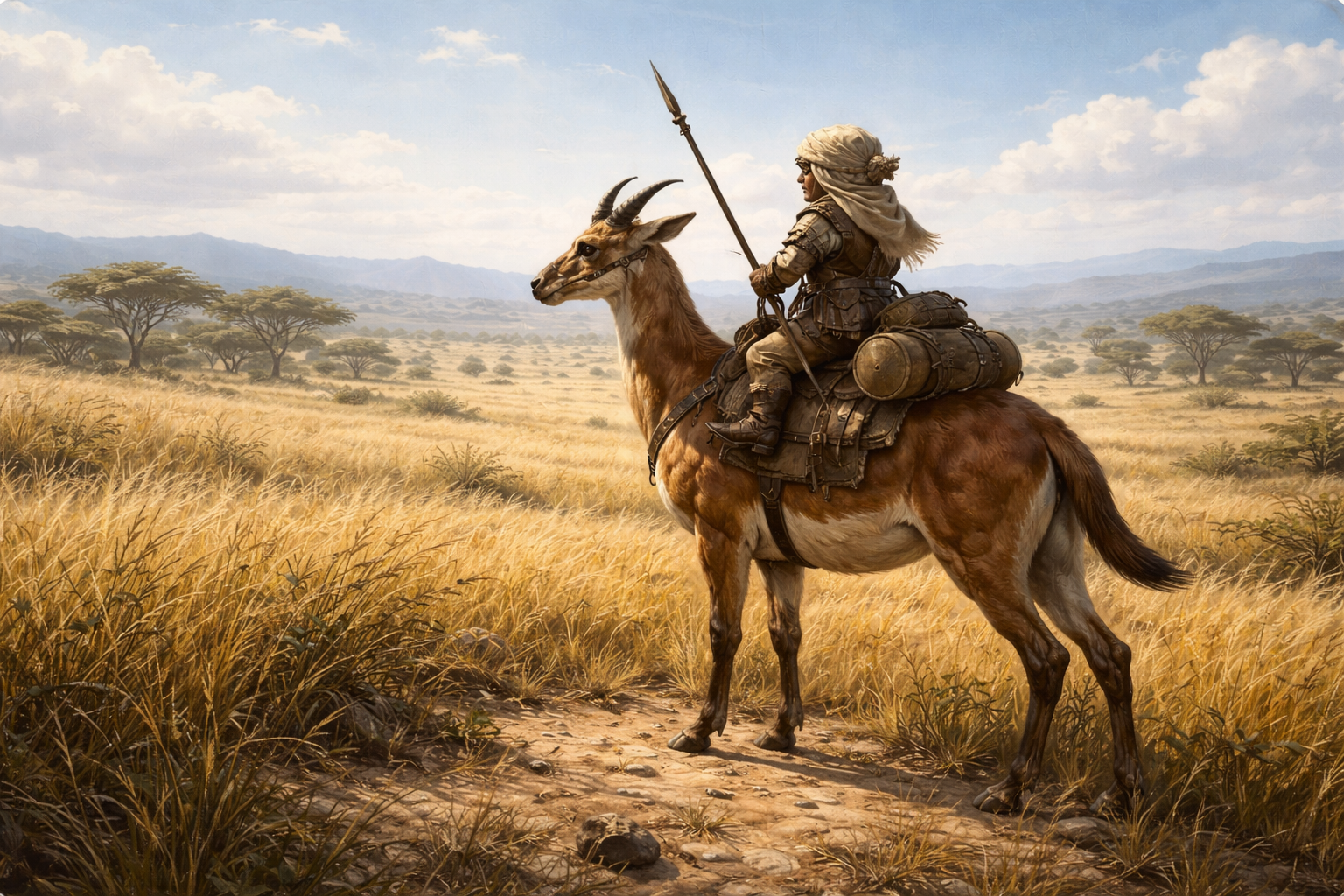
The Karven has become the defining companion of halfling mobility—a patrol mount, messenger platform, and symbol of quiet vigilance.
For biological details of the species, see:
Karven
Origins of the Partnership
Early halfling settlements along savanna trade corridors required:
-
Boundary awareness
-
Predator monitoring
-
Bandit deterrence
-
Message relay between villages
Horses were available through human neighbors but were larger than necessary and less efficient in heat under halfling riders.
The Karven proved better suited:
-
Proportionally matched to halfling size
-
Agile and heat tolerant
-
Capable of sustained patrol circuits
-
Less intimidating to neighboring communities
Over time, halflings refined selective breeding lines, favoring stability, strong backs, and even temperament.
The relationship evolved from utility to identity.
Riding Style and Equipment
Halflings ride with:
-
Low saddle profiles
-
Light frame saddles
-
Balanced rear pack systems
-
Minimal bridle pressure
Given halflings’ compact build and excellent balance, much steering is achieved through weight shift rather than force.
Karven tack is designed for:
-
Even load distribution
-
Compact storage
-
Efficient access to gear
Even when traveling, halflings maintain standards.
A patrol rider may carry:
-
A compact cooking pot
-
A small kit of spices
-
Proper eating utensils
-
Durable but pleasant tableware
-
Quality tea leaves or dried herbs
Practicality and comfort coexist.
Defensive Role
Karven riders serve as:
-
Village boundary patrol
-
Trade-route observers
-
Messenger relays
-
Sheriff-style circuit riders
They are not shock cavalry.
Typical arms include:
-
Short composite bows
-
Light spears
-
Slings
-
Short blades
If threatened, Karven may defend themselves with horn and hoof, but their strength lies in mobility and early response rather than engagement.
Mixed patrols with human riders are common in shared settlements, though humans rarely ride Karven.
Cultural Significance
Across the savanna, phrases such as:
“Storm’s coming off the Shine.”
“We’ll make the circuit before dusk.”
are often spoken from a Karven saddle.
The sight of a halfling rider cresting a grassy rise signals:
-
Watchfulness
-
Stability
-
Quiet readiness
The Karven is not a symbol of conquest.
It is a symbol of presence.
Conclusion
Savanna halflings do not seek war.
But neither do they ignore risk.
The Karven allows them to extend their reach without sacrificing their way of life—civilized, steady, and prepared.
Where others see grassland horizon, halflings see patrol routes.
And where the grass bends low beneath a running shadow, guardians are already moving.